Arizona's monsoon season winds down in mid to late September, and that is when the underground bill comes due. The storms are over, the parking lots have dried, and everything looks fine from the surface. Meanwhile, several inches of rain that fell in under an hour has already moved soil, filled vaults, floated conduit, and opened voids under pavement that nobody will notice until a delivery truck parks on the wrong spot.
This guide walks through what monsoon rain actually does to buried utilities in the Phoenix Metro, the failure modes worth looking for on a commercial site, and how to confirm what is happening down there without cutting into live lines. It is written for the people who get the phone call when the asphalt cracks: property managers, facility teams, general contractors, and public works staff across Gilbert, Mesa, Chandler, Tempe, Queen Creek, San Tan Valley, and Apache Junction.
What Monsoon Rain Actually Does Underground
Desert soil is a poor sponge. Through the dry season, Sonoran soils shrink and crack, and the surface bakes into a crust that sheds water instead of absorbing it. When a monsoon cell dumps its load, most of that water runs sideways across the site, finds the lowest resistance path, and pours down through cracks, curb joints, landscape edges, and the seams around utility structures.
The lowest resistance path is very often an old utility trench. A trench that was open cut and backfilled is, by definition, disturbed ground sitting inside undisturbed ground. Even a well compacted trench is looser than the native material beside it, so water travels along it like a French drain, moving fines out of the backfill as it goes. Engineers call the result subsurface piping: a hidden channel forming underground while the surface stays intact.
Once fines wash out, the backfill loses volume. It settles. If there is pavement over the top, the pavement briefly bridges the gap, and you get a void, an empty pocket with a thin asphalt lid over it. That is the condition that turns into a sinkhole weeks or months after the storm that caused it.
Why Bored Lines Hold and Backfilled Trenches Sink
This is the practical argument for trenchless work in a monsoon climate, and it is worth understanding rather than taking on faith. A horizontal directional bore installs conduit through undisturbed native soil. There is no trench prism, no backfill column, and no compaction seam running along the alignment. Water has no preferential channel to follow, so the ground around the duct behaves the way the ground around it always has.
An open cut trench creates that channel on day one. Good compaction, proper lift thickness, and the right bedding material all reduce the risk substantially, and there are plenty of jobs where open cut is the correct call. But after a heavy monsoon year, the settlement complaints on a commercial property almost always trace back to trench lines, pavement patches, and structures, not to bored alignments.
That difference is also why re-digging a failed line is often the wrong repair. Re-opening the same trench re-creates the same weakness in the same place, in soil that has already proven it will move.
Five Failure Modes to Look For After a Storm
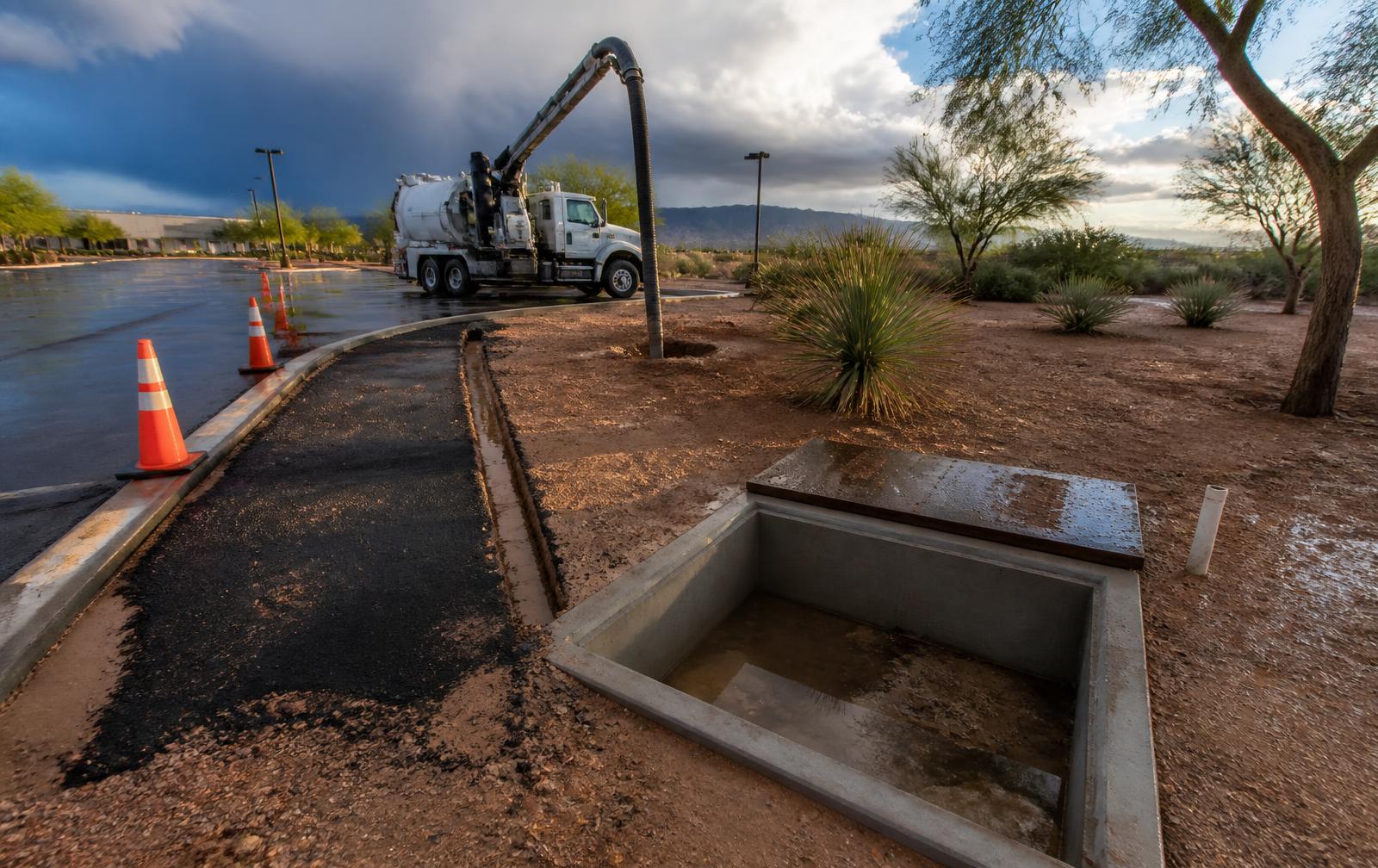
1. Vault and handhole silt inundation. Water carries fine sediment into pull boxes, splice vaults, and handholes through lid seams and unsealed conduit entries. Silt packs around splice trays and slack loops, holds moisture against hardware, and makes any future work slow and messy. A vault half full of mud is also a vault you cannot inspect.
2. Conduit float and displacement. An unanchored duct bank sitting in a water filled trench wants to rise. Empty conduit is buoyant. When the trench floods before the backfill has fully consolidated, ducts can shift upward or sideways, reducing cover depth and changing the alignment your as-builts say is there. Reduced cover is a strike risk for the next crew on site.
3. Sinkholes and voids along road shoulders and lot edges. These form where runoff concentrates: shoulder drop offs, curb cuts, catch basin surrounds, and the ends of trench runs. The tell is usually subtle before it is dramatic, a soft spot, a puddle that appears in a place that never held water, or a hairline crack pattern in a rough oval.
4. Settled pavement patches. Look at every asphalt or concrete patch on the property, since a patch marks a past excavation. A patch that now sits below the surrounding grade, or that has cracked around its perimeter, is telling you the backfill under it has lost volume.
5. Exposed, strained, or ponded fiber and electrical runs. Where a wash, swale, or drainage channel crosses a utility corridor, erosion can strip cover off a shallow run entirely. Check any location where the ground surface changed shape during the storm season, and check vaults that now hold standing water against cable and closures.
How to Confirm It Without Cutting Into Live Lines
Visual inspection tells you where to worry. It does not tell you what is actually happening two to six feet down, and guessing with a backhoe next to a live fiber trunk or an energized primary is how outages and injuries happen.
Vacuum excavation, also called potholing or daylighting, is the standard non-destructive answer. Air or water breaks up soil in a small controlled hole and a vacuum removes the spoil, exposing the utility without ever putting steel against it. On a post-monsoon inspection, vacuum potholing at a few targeted points confirms real depth versus record depth, shows whether the duct has floated or deflected, reveals joint separation or crushing, and lets you see whether the surrounding soil is intact or has washed out into a void.
It is also the compliant answer. Arizona law requires contacting Arizona 811 before digging, and within the tolerance zone around a marked line, non-destructive methods are the accepted way to expose it. Potholing is what produces the highest confidence subsurface information available short of full excavation.
Ground penetrating radar earns its place when you need to search area rather than confirm a point. GPR can sweep a parking bay or a stretch of drive aisle looking for anomalies that suggest voids, which then get verified with a pothole. Radar performance varies with soil moisture and conductivity, so treat it as a screening tool that tells you where to dig a small hole, not as a final verdict on its own.
Repairing Without Re-Digging
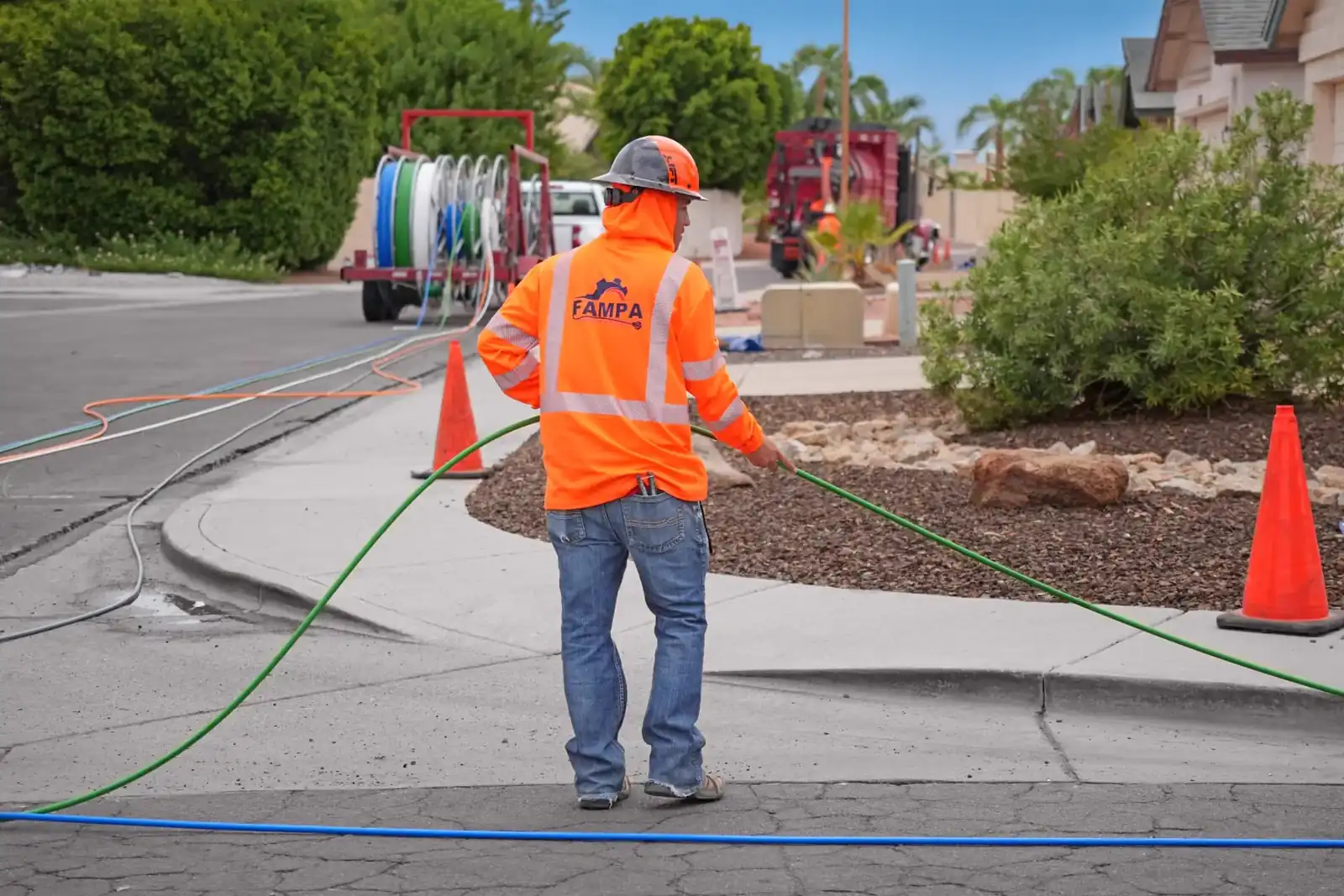
When potholing confirms a damaged or displaced run, the repair strategy matters as much as the diagnosis. Directional drilling lets a crew install a new conduit path beneath the failure zone entirely, through undisturbed soil, and pull cable into the new sleeve. The compromised section can then be abandoned in place or cut out at the ends, and the parking lot, drive aisle, or landscape above it never opens.
For voids under pavement, the sequence is straightforward: confirm the extent, remove or stabilize the loose material, restore structural fill in controlled lifts or with flowable material, then repair the surface. Skipping the confirmation step and simply repaving over a void buys a few months at most.
The decision between trenchless repair and open cut comes down to depth, length, what is above the alignment, and how much surface disruption the site can absorb. A short run under landscape may not justify a bore. A crossing under an active drive aisle, an occupied retail frontage, or a county roadway almost always does.
A Seven Point Post-Monsoon Walk-Through
You can run this yourself in an hour on most commercial properties, ideally with the site's utility as-builts in hand.
1. Walk every pavement patch and trench line. Note any patch that has settled below grade or cracked around its edges.
2. Open and look into every accessible vault, handhole, and pull box. Photograph silt levels, standing water, and any cable or closure sitting in mud.
3. Check the ground around every at-grade structure: vault lids, transformer pads, pedestals, light bases, and catch basins. Separation or depression at the edges means soil is moving.
4. Test soft spots. Where the surface looks or feels different, tap or probe. Hollow response or unusual give under foot is worth flagging.
5. Look for new water paths. Erosion scars, deposited sediment fans, and fresh channels show where runoff concentrated, which is where cover has most likely been lost.
6. Inspect washes, swales, and drainage crossings for any exposed conduit, cable, or warning tape.
7. Write it down with photographs and locations. A dated record turns a vague concern into a scope an estimator can actually price, and gives you documentation if the damage becomes an insurance or warranty question.
When to Call a Contractor
Call when you find a void or a hollow sounding area under pavement, when a settled patch sits over a known utility, when a vault is full enough that cable is submerged, when cover depth over any line looks reduced, or when you simply cannot tell what you are looking at and the line underneath matters.
Fampa Construction runs directional drilling, vacuum potholing, and underground conduit work out of Gilbert across the Phoenix Metro, and post-monsoon inspection season is exactly what fall scheduling is for. Getting a subsurface assessment on the calendar in late September or October also puts any needed repair ahead of the holiday street cut restrictions that Valley cities apply to roadway work later in the year.
Call the Gilbert office at (602) 859-9765 to schedule a post-monsoon inspection or a vacuum potholing audit, or send over site drawings and we will tell you what we would look at first.
Need an Arizona HDD or Fiber Contractor?
Talk to a Fampa Construction project manager, site walks scheduled fast and bids built around your scope, footage, and schedule.